Future of Payroll in SMEs: How Automation is Changing the Game
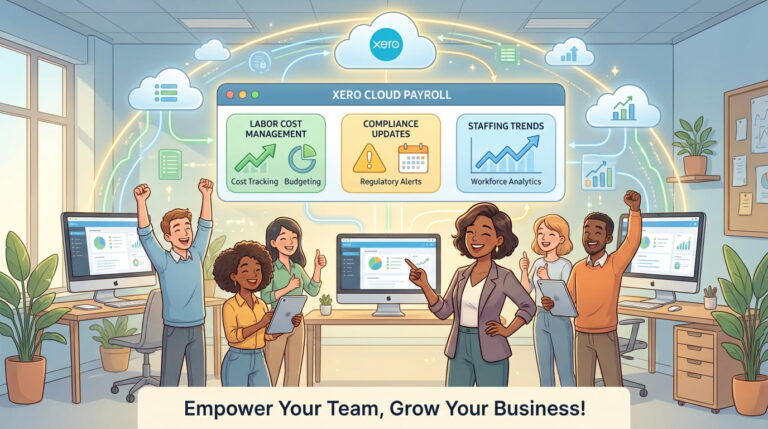
Payroll is evolving rapidly; automation helps SMEs reduce errors, save time, ensure compliance, and transform payroll from task to strategy.
For years, payroll has been one of the most time-consuming, error-prone, and compliance-heavy tasks for small businesses. It never stops. It never slows down. And it rarely forgives mistakes. But the landscape is shifting fast. Automation—once reserved for large enterprises—is now accessible to every SME using cloud tools, integrated systems, and AI-powered workflows.
The result? Payroll is transforming from a monthly stress point into a streamlined, near-self-running function that strengthens compliance, improves accuracy, and gives business owners something they rarely get: time back.
Payroll automation saves small businesses time, reduces errors, and helps ensure compliance with complex tax and labor laws.
Here’s how automation is reshaping payroll for SMEs—and what the future looks like.
Read more: Cloud Payroll & Strategic Insights
- How Cloud Payroll Services Improve Accuracy, Efficiency, and Compliance
- The Role of Payroll Data in Strategic Business Decisions
- Why SMEs Are Moving to Cloud-Based Payroll Services
1. Payroll Is Moving From Manual Inputs to “Set-and-Forget” Workflows
Traditional payroll required owners or bookkeepers to manually enter hours, update rates, calculate entitlements, and double-check awards. Automation replaces these repetitive tasks with rules that run in the background.
Modern systems now automatically:
- Calculate overtime based on mapped awards
- Apply leave entitlements as per employment type
- Sync timesheets to payroll without re-entry
- Update super and tax rates from real-time data
- Detect anomalies such as missing hours or unusual shifts
For SMEs, this means payroll accuracy is no longer dependent on a human remembering dozens of compliance rules—it’s built into the system.
Fewer errors, lower risk, and payroll that essentially runs itself once set up correctly.
2. Real-Time Compliance Reduces Penalties and Unwanted ATO Attention
The ATO has intensified its focus on payroll governance, data accuracy, and timely reporting through systems like STP Phase 2. For SMEs juggling hiring, operations, and cash flow, this creates pressure.
Automation reduces this risk significantly.
Systems now:
- Validate employee details (TFN, employment type, DOB)
- Auto-categorise income types and allowances
- Flag expired visas or mismatched information
- Warn you about missing super contributions before deadlines
- Generate compliant reports without manual formatting
Compliance shifts from reactive to proactive. Instead of scrambling to fix errors after lodgement, SMEs prevent them upfront.
Read more: Payroll Management & Optimization
- Cash Flow Risks from Poor Payroll Management and How to Fix Them
- Employee Payment Errors: Why They Happen and How Xero Fixes Them
- Xero Payroll vs Other Payroll Software: Which is Best for SMEs?
- In-House Payroll vs Outsourced Payroll: Pros, Cons, and Xero Benefits
- Cost of Payroll Errors vs Investing in Payroll Services
- Why SMEs Choose Xero Payroll Over Manual Accounting
- Monthly Payroll Checklist for Small Businesses Using Xero
- 7 Payroll Reports Every SME Should Track in Xero
- Automated Payroll Tasks You Can Implement in 30 Minutes
3. Timesheets and Rostering Are Becoming Fully Integrated
The gap between “hours worked” and “hours paid” has always been a source of conflict and mistakes.
Automated payroll bridges that gap.
Integrated systems link:
- Rosters
- Timesheets
- Pay runs
- Ledger entries
This eliminates the inaccuracies caused by handwritten timesheets, WhatsApp “shift updates,” or last-minute changes scribbled on paper.
Automation ensures:
- Staff only clock in for rostered shifts (or request approval)
- Breaks and loadings apply automatically
- Overtime rules trigger instantly
- Timesheets flow straight into payroll with zero re-keying
SMEs get cleaner data, and employees get transparent, accurate payslips.
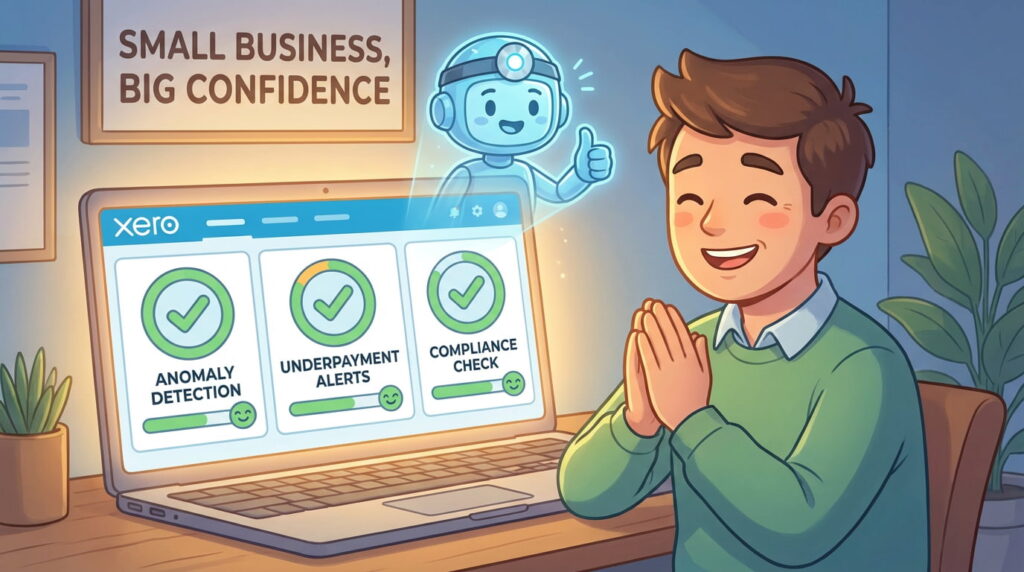
4. AI Detects Payroll Anomalies Before They Become Problems
AI is not replacing payroll—it’s making it smarter.
Leading systems are now using AI to:
- Spot unusual spikes in payroll costs
- Compare staff pay trends
- Detect pay rate inconsistencies
- Predict compliance issues
- Flag underpayment risks
Instead of finding mistakes after an audit or employee complaint, businesses get real-time alerts like:
“This employee is paid at a rate lower than the award minimum.”
“This shift appears to violate maximum daily hours.”
“Super contributions for the month are lower than expected.”
AI becomes a second set of eyes, constantly scanning payroll for risk.
Read more: Payroll Tax Filing Guides (Region-Specific)
- Filing Payroll Taxes in Xero: A Simple Guide for Australian Small Businesses
- How to File Payroll Taxes in Xero: A Clear Guide for U.S. Small Business Owners
- What Every United Kingdom Small Business Should Know About Filing Payroll Taxes in Xero
- How to File Payroll Taxes in Xero: A Clear Guide for New Zealand Small Business Owners
- Filing Payroll Taxes in Xero: A Clear Guide for Singapore Small Businesses
5. Employee Self-Service Eliminates Hours of Admin
One of the biggest hidden payroll burdens is answering staff questions:
- “Can you resend my payslip?”
- “Can I update my bank details?”
- “How much leave do I have?”
- “I forgot to submit my timesheet.”
Automation puts all this directly in employees’ hands.
Through self-service apps, employees can:
- Update bank and super details
- Submit and track leave
- View timesheets and payslips
- Check rosters
- Sign onboarding documents
This reduces admin time dramatically and ensures employee data stays accurate—one of the most common sources of payroll errors.
6. Onboarding Is Becoming Instant and Fully Digital
SMEs used to rely on paper forms and manual data entry. Now, onboarding is fully digital.
The future of automated onboarding includes:
- Digital tax file number declarations
- Auto-generated employment contracts
- Instant collection of bank and super details
- Right-to-work verification
- Role-based pay templates
Once an employee is onboarded digitally, their data flows into payroll with zero manual input. Mistakes like wrong TFN, incorrect employment status, or missing super details are far less likely.
7. Payroll Is Becoming a Strategic Business Tool, Not an Admin Task
When payroll data is accurate, real-time, and automated, it becomes valuable beyond compliance.
SMEs can now use payroll data to:
- View labour costs per role, location, or project
- Forecast staffing needs
- Predict cash flow impacts
- Identify high and low productivity periods
- Compare overtime costs to hiring a new employee
Automation turns payroll into a business insight engine—not just a monthly chore.
8. Integration With Accounting and HR Creates a Connected System
The future of payroll is not isolated—it’s interconnected.
Automation enables seamless integration between:
- Payroll
- Accounting
- HR
- Time tracking
- Leave management
- Workforce planning
- Expense management
This eliminates data silos. Changes in one system update everywhere automatically.
SMEs benefit from:
- Real-time expense and payroll sync
- Cleaner reconciliations
- Instant financial reporting
- Faster month-end close
- Transparent labour cost tracking
Everything becomes part of a single digital workflow.
9. The Future: Predictive Payroll and Fully Automated Pay Runs
We’re entering a stage where payroll won’t just run automatically—it will predict needs before you see them.
Upcoming automation trends include:
- Forecasted payroll cost before pay run
- Predicted cash flow impact
- Alerts for upcoming awards or rate changes
- Automatic pay runs triggered by complete timesheets
- Policy-based exceptions (e.g., auto-approval of standard shifts)
This future leaves SMEs with one job: reviewing and approving—not processing.
10. What SMEs Should Do Today to Prepare
Automation doesn’t require a big transformation. SMEs can begin with small steps:
- Move to a cloud payroll system if still using spreadsheets or desktop tools.
- Digitise onboarding forms to reduce data errors.
- Connect timesheets and payroll to eliminate manual entry.
- Turn on automatic super, tax, and compliance updates.
- Review payroll rules and awards to ensure correct automation.
- Use employee self-service to reduce admin load.
- Integrate payroll with accounting for real-time reporting.
These steps alone can reduce 60–80% of payroll effort and significantly lower error rates.
Final Thoughts
The future of payroll in SMEs is defined by one word: automation.
Not as a luxury, not as a trend—but as a necessity.
SMEs that embrace automated payroll gain:
- Consistent compliance
- Faster processing
- Fewer errors
- Better visibility
- Lower admin time
- Happier teams
And most importantly, they free up mental and operational space to focus on growth—not paperwork.
Automation isn’t just changing payroll.
It’s changing how small businesses run.
For SMEs looking to simplify payroll and embrace automation, partnering with a trusted payroll service can ensure accuracy, compliance, and peace of mind.