
Cash Flow Risks from Poor Payroll Management and How to Fix Them
Payroll mistakes drain cash fast — from mis‑calculations to late pays, even small errors build stress, cash crunch, distrust… and you wonder: can it be fixed?
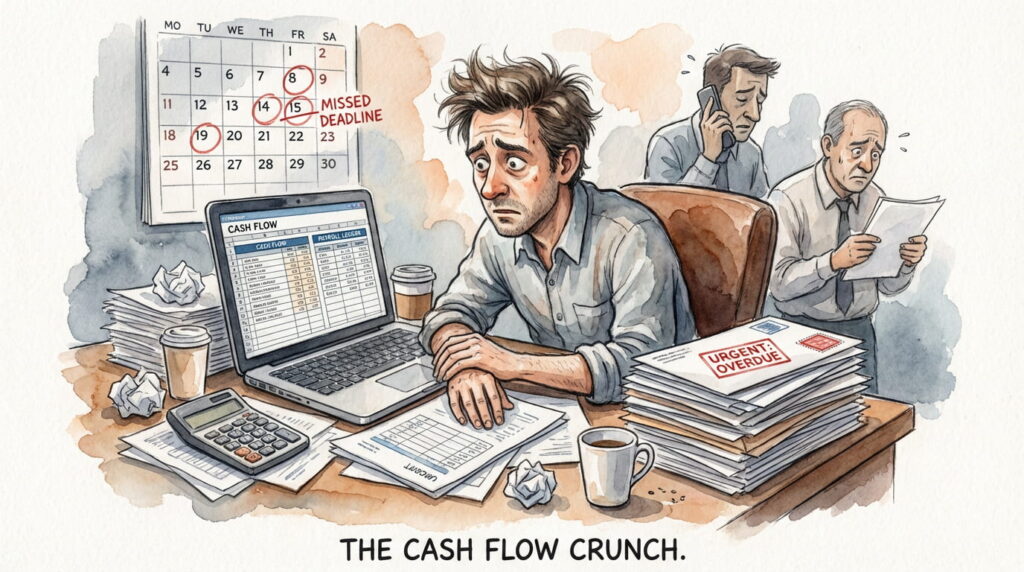
You run a small boutique — you love your work, your team feels like family. But one month after a lean spell, your bank balance feels tight. Payroll day comes — and there isn’t enough cash for salaries. You scramble. Staff notices. Anxiety rises.
You breathe deeply. This is not just a cash‑flow hiccup. It’s fear. Fear of losing trust, of losing people, of being unable to deliver.
Sadly, many small businesses face this — not because of poor sales or bad luck — but because payroll management was overlooked. Whether misclassifying staff, missing tax deadlines, or relying on manual spreadsheets. And when payroll errors pile up, cash flow suffers.
Businesses overwhelmed by payroll errors often lack buffer days in cash reserves. Research by the JPMorgan Chase Institute found that the typical small employer business had only 18 cash‑buffer days — meaning just a few late wins could derail salary payments.
But there’s hope. With the right tools — and the right process — you can transform payroll from dreaded chore into a source of clarity and confidence.
Poor payroll leads to cash‑flow strain, compliance risks, and staff distrust. Simple errors like mis‑calculations or delayed payments can trigger big consequences. Automating payroll (e.g., with Xero payroll) or using structured workflows restores stability.
Let’s explore why payroll mismanagement hurts cash flow — and how to fix it.
Read more: Xero Payroll Setup & Guides
- The Ultimate Guide to Xero Payroll for Small Businesses
- How to Set Up Xero Payroll for Your Small Business
- Running Your First Payroll in Xero: Tips for Accuracy
- Automating Payroll Calculations in Xero: Step-by-Step
- Processing Employee Leave, Overtime, and Bonuses in Xero Payroll
Why Poor Payroll Management Undermines Cash Flow
Understand how common payroll problems translate into cash flow risks.
A mis‑calculation here, a missed compliance deadline there — payroll is full of moving parts.
Errors in calculations — Wrong salary amounts, incorrect tax or deduction calculations, or misclassification of employees vs. contractors. These lead to underpayment or overpayment.
Manual processes and outdated systems — many small businesses still rely on spreadsheets or paper-based payroll. Manual data‑entry means greater chance of mistakes.
Compliance mistakes — late or incorrect filings of taxes, social security, statutory contributions (in jurisdictions where applicable). These can invite penalties, back payments, audits.
A consultancy firm misclassified a contractor as full-time — payroll calculations undercharged taxes, and records later required correcting. The result: unexpected tax liability, fines, and cash flow disruption.
For most small businesses, payroll is among the largest recurring outflows. The volatility in payroll — new hires, layoffs, bonuses — makes planning tricky. Without accurate forecasting, payroll itself becomes a risk factor.
What goes wrong if ignored: You may face cash shortages on payday, surprise liabilities, decreased trust, possible legal exposure.
Knowing the risk is half the battle. Next: what clarity and process can bring.
Read more: Payroll Management & Optimization
- Cash Flow Risks from Poor Payroll Management and How to Fix Them
- Employee Payment Errors: Why They Happen and How Xero Fixes Them
- Xero Payroll vs Other Payroll Software: Which is Best for SMEs?
- In-House Payroll vs Outsourced Payroll: Pros, Cons, and Xero Benefits
- Cost of Payroll Errors vs Investing in Payroll Services
- Why SMEs Choose Xero Payroll Over Manual Accounting
- Monthly Payroll Checklist for Small Businesses Using Xero
- 7 Payroll Reports Every SME Should Track in Xero
- Automated Payroll Tasks You Can Implement in 30 Minutes
How Structured Payroll Systems Bring Clarity (and Stability)
Show how reorganizing payroll processes helps prevent cash flow crises.
Imagine replacing your spreadsheet with a system that auto‑calculates gross/net pay, tax deductions, statutory contributions.
- Accurate calculations, every time — you reduce mis‑payments and tax‑errors.
- Consistent record‑keeping — audit‑ready, transparent.
- Forecastable cash outflows — easier planning, reserve-setting, liquidity management.
For many small businesses (retail shops, service agencies, consultancies, contractors), this shift from manual to system means fewer surprises.
A recent analysis showed many small businesses spend several hours monthly wrestling with payroll tax issues; automation cuts that load drastically.
Without consistency, businesses can’t forecast cash-outflows reliably — making them vulnerable to revenue dips or delayed receivables.
Old: spreadsheet, manual entries, ad‑hoc adjustments, stress before payday.
New: system or tool (or outsourced payroll), scheduled pay runs, automated tax/deduction logic, ready‑made payslips, forecast‑driven reserve planning.
This matters — especially if you want to scale or keep staff morale high.
Read more: Payroll Compliance & Mistakes
- Top 5 Payroll Mistakes Small Businesses Make and How Xero Solves Them
- Payroll Compliance Nightmares and How Xero Prevents Them
- Common Payroll Mistakes SMEs Make and How to Avoid Them
Fixing Payroll for Cash Flow: Practical Steps
Intent: Provide actionable, realistic steps small businesses can apply immediately.
Step 1: Choose a reliable payroll tool (e.g. Xero Payroll).
- Automates calculations.
- Maintains audit trail.
- Sends reminders for tax/filing deadlines.
Step 2: Build a cash buffer reserve.
- Set aside enough cash to cover at least 2–3 pay cycles.
- Helps bridge lean months or delayed client payments.
Step 3: Maintain accurate, up-to-date employee data.
- Clear classification (employee vs contract).
- Records for hours, bonuses, deductions.
- Timely updates for joins, exits, leaves.
Step 4: Schedule payroll runs and tax compliance timelines.
- Fixed calendar for pay dates, filings.
- No last-minute scrambling.
Step 5: Monitor cash flow monthly (or weekly).
- Forecast upcoming salaries + obligations.
- Compare against expected income.
- Spot potential cash gaps early — then take action (defer expenses, hold hiring, adjust cash buffer).
Use case across industries:
- A small cafe planning seasonal staff — sees payroll spike in summer, uses buffer to manage lean winter months.
- A consultancy billing clients monthly — with automated payroll, easily aligns pay-runs with receivables.
- An e-commerce startup scaling up — avoids cash crunch even while hiring contractors and employees.
I’ve seen creative agencies survive early months by automating payroll. Mistakes dropped, morale stayed high, and cash flow became predictable — giving founders breathing space to focus on growth.
What Happens If You Ignore Payroll Risk
Highlight the compounding risks over time.
- Cash flow crunches — frequent shortages, delayed wages, reactive borrowing.
- Compliance penalties — tax fines, legal exposure, audit costs.
- Employee distrust, morale drop, turnover — people leave; hiring costs go up.
- Scaling becomes impossible — instability discourages expansion or new hires.
One retailer delayed pay for two months due to cash shortage. Employee churn spiked. Repeat customers noticed staffing gaps. Growth stalled.
This downward spiral often begins with small payroll mistakes — but ends with reputational and financial damage.
Quick Checklist: Fix Payroll & Guard Cash Flow
- Choose a payroll system (like Xero Payroll) or outsource to expert provider
- Automate calculations — gross, net, taxes, deductions
- Build and maintain a cash buffer reserve
- Maintain accurate employee data and classifications
- Set regular payroll and compliance schedules
- Forecast payroll outflows vs income monthly
Read more:
- The Ultimate Guide to Xero Payroll for Small Businesses
- How to Set Up Xero Payroll for Your Small Business
- Automating Payroll Calculations in Xero: Step-by-Step
- Processing Employee Leave, Overtime, and Bonuses in Xero Payroll
- Filing Payroll Taxes in Xero: A Simple Guide for Australian Small Businesses
- How to File Payroll Taxes in Xero: A Clear Guide for U.S. Small Business Owners
- What Every United Kingdom Small Business Should Know About Filing Payroll Taxes in Xero
- How to File Payroll Taxes in Xero: A Clear Guide for New Zealand Small Business Owners
- Filing Payroll Taxes in Xero: A Clear Guide for Singapore Small Businesses
- Running Your First Payroll in Xero: Tips for Accuracy
- Xero Payroll for Creative Agencies: Paying Contractors Made Simple
- Payroll Management in Retail & Hospitality SMEs Using Xero
- Freelancers and Consultants: Simplifying Payroll With Xero
- Payroll Compliance for Health & Wellness SMEs Using Xero
- Top 5 Payroll Mistakes Small Businesses Make and How Xero Solves Them
- Payroll Compliance Nightmares and How Xero Prevents Them
Conclusion
By fixing payroll processes — automating calculations, scheduling pay runs, maintaining accurate records, and building reserves — you turn payroll from a cash‑flow risk into a foundation of stability.
You stop living payday to payday. You avoid compliance penalties. You protect employee trust.
Imagine — regular, timely payroll; predictable cash flow; no sleepless nights worrying about funds.
Take a small step toward clarity today — and build a steady, stress‑free financial backbone for your business.
If you want help setting up payroll workflows or integrating payroll tools for your business, I’m here to get you started.